Florida Building Code for Roofs in 2026: What Homeowners Need to Know
The plain-English version of the Florida Building Code rules that govern your roof: what HVHZ means, what your county inspector is looking for, and why this is good news for homeowners.
If you have ever asked a Florida roofer "is this up to code" and gotten a vague answer, this guide is for you. The Florida Building Code (FBC) for residential roofing is genuinely complicated, but the parts that matter to homeowners are not. Here is the plain-English version of what the code requires, what your county inspector is looking for, and why all of this is actually good news for you as a homeowner.
What the FBC covers
The Florida Building Code is the statewide building code that governs new construction and most renovation work in Florida. It is updated on a cycle (the current edition is the 8th edition, FBC 2023, with periodic supplements), and every Florida county enforces it through their local building department.
The code covers structural design, wind loads, moisture protection, fire safety, energy efficiency, and accessibility. For roofs, the parts that matter most to homeowners are: wind design, fastening, underlayment, flashing, and product approval.
The High-Velocity Hurricane Zone (HVHZ)
If you live in Miami-Dade or Broward County, your roof is in the HVHZ. This is the strictest residential wind code zone in the United States. The code was written after Hurricane Andrew in 1992 and tightened again after the 2004 to 2005 hurricane seasons.
In the HVHZ:
Every roofing product (shingle, tile, metal, underlayment, fastener, flashing) has to carry a Miami-Dade Notice of Acceptance (NOA) for HVHZ use. The NOA is a real document, with a real number, issued by Miami-Dade County after the product passed real wind and impact tests.
The fastener pattern is more aggressive than non-HVHZ areas. More nails per shingle, more fasteners per tile, closer spacing on metal panels.
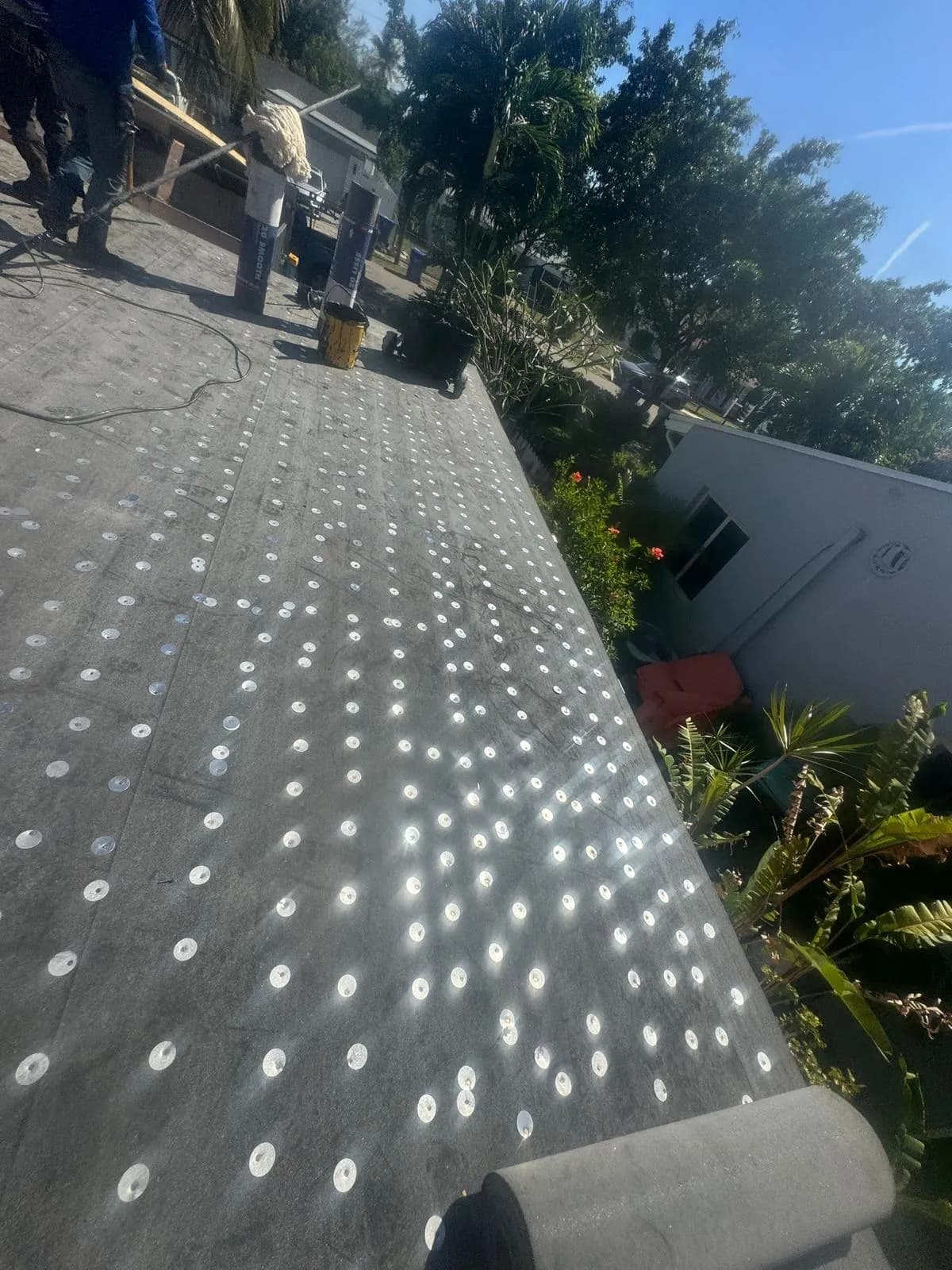
Underlayment is required to be self-adhering (peel-and-stick) at the perimeter and in valleys, with synthetic underlayment over the field. The "double-felt" install common in older roofs is no longer compliant.
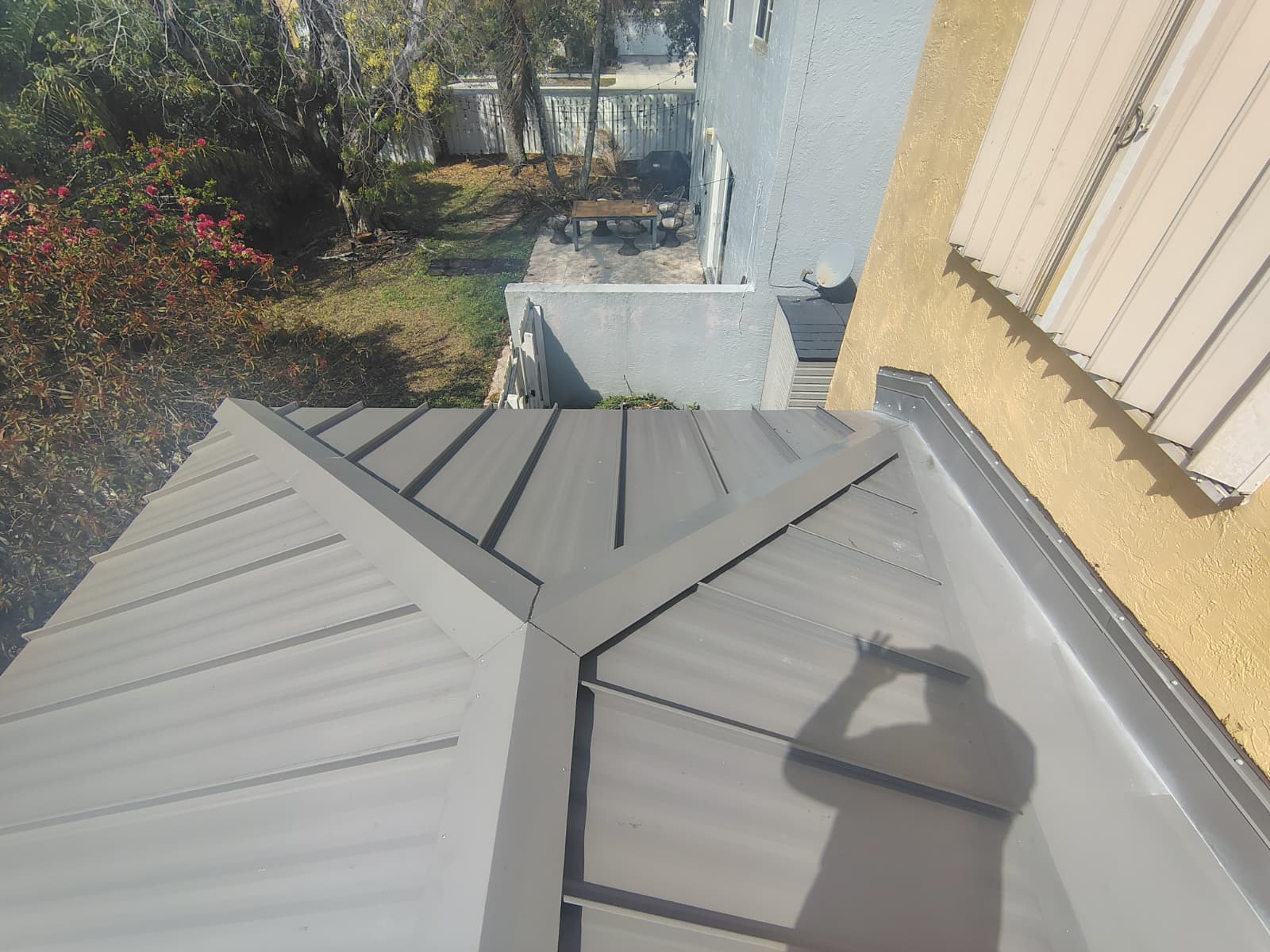
Flashing details are spelled out by the code. Step flashing at sidewalls, counter-flashing at chimneys, valley metal type and width, drip edge at the eaves, and ridge vent at the peak all have specific requirements.
Palm Beach County is not technically in the HVHZ but has very similar wind requirements. Most contractors install Palm Beach roofs to HVHZ-equivalent standards because the wind loads are comparable.
Wind speed and roof design
The FBC assigns every Florida address an "ultimate design wind speed" based on the FEMA wind map. South Florida ultimate wind speeds run from about 170 mph at the coast down to 150 to 160 mph inland.
What this means: every component of your roof (the shingle, the tile, the metal panel, the fastener pattern, the flashing) has to be rated for the actual wind speed at your address. A shingle rated for 130 mph cannot be installed on a Miami-Dade home where the design wind speed is 170 mph.
This is why "Miami-Dade NOA approved" matters so much. The NOA verifies the product was tested to the actual wind speed your address requires.
Permits and inspections
Any roof replacement in Florida requires a building permit. The permit application goes through your county building department (or city building department, depending on jurisdiction). The contractor is the contractor of record on the permit.
After the existing roof is torn off, the inspector visits the site to verify:
The deck is sound (no rotten plywood remains, all sheets properly fastened).
The dry-in is correct (peel-and-stick where required, synthetic underlayment over the field, proper overlap).
The flashing details are right at every penetration.
Once dry-in passes, the contractor installs the shingle, tile, or metal. After the final layer is installed and the cleanup is complete, the inspector returns for the final inspection. The permit is closed when the inspector signs off.
If a contractor offers to skip the permit "to save you money", the answer is no. An unpermitted roof becomes a problem at resale, at the next insurance renewal, and at the next storm claim. We pull every permit, every time.
Why all of this is actually good news
The Florida Building Code is the reason a 2026 South Florida roof is dramatically better than a 1995 South Florida roof. Better materials, better install practice, better fastening, better flashing, better long-term performance.
Properly installed, a code-compliant 2026 Florida roof:
Survives hurricane winds that would have peeled off a 1995 roof.
Earns the maximum wind-mitigation insurance credit (which means lower annual premiums for the next 30 years).
Carries manufacturer warranties that are actually enforceable because the install method matches the manufacturer specifications.
Holds up against UV, moisture, and algae for the full warranty life when paired with the right material specifications.
The code is also the reason "cheap" roofing offers in Florida are almost always cutting code corners. The cost difference between a properly code-compliant install and a code-shortcut install is meaningful, and the cost difference shows up in the lifespan and the next insurance renewal.
What homeowners should ask a roofer
Five questions that separate real contractors from corner-cutters:
What is the Miami-Dade NOA number for the shingle, tile, or metal you are quoting?
What underlayment are you installing in the perimeter, in valleys, and over the field?
What is the fastener pattern, and does it meet the code for our wind zone?
Are you pulling the building permit, and will I have a copy of the closed permit at the end of the project?
What wind-mitigation credits will my new roof qualify for, and will you provide the documentation for the inspection?
Real answers look like specific products, specific install methods, and specific permit numbers. Vague answers are a warning sign.
The bottom line
The Florida Building Code is the homeowner's friend. It is the reason your new roof is meaningfully better than the one it replaces, the reason your insurance premium drops after install, and the reason you can sleep through a hurricane season without checking weather alerts every six hours.
If you are planning a 2026 Florida roof replacement, the code conversation is the conversation that protects your install for the next 30 years. We are happy to walk you through the specific requirements for your address and your existing roof. No pressure, just the actual code and the actual install method we will use.